The Story Atlas
The map of your story, drawn automatically.
Every character, place, and thread in your novel, connected the way your chapters connect them. It draws itself from what you write in the Pantser workspace. There is no diagram to maintain. Your world, the way it actually is.
See my story as a map, free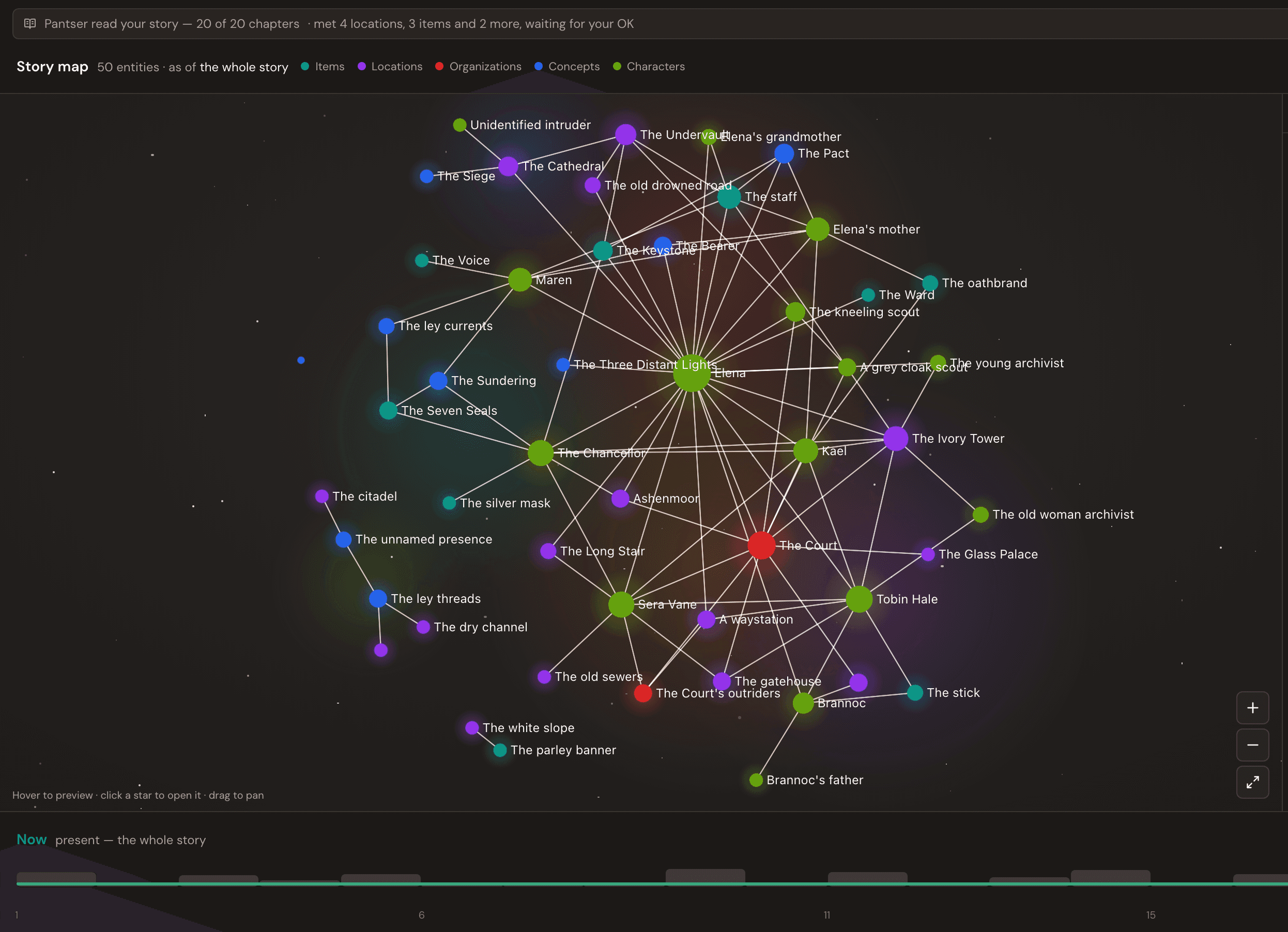
The time scrubber
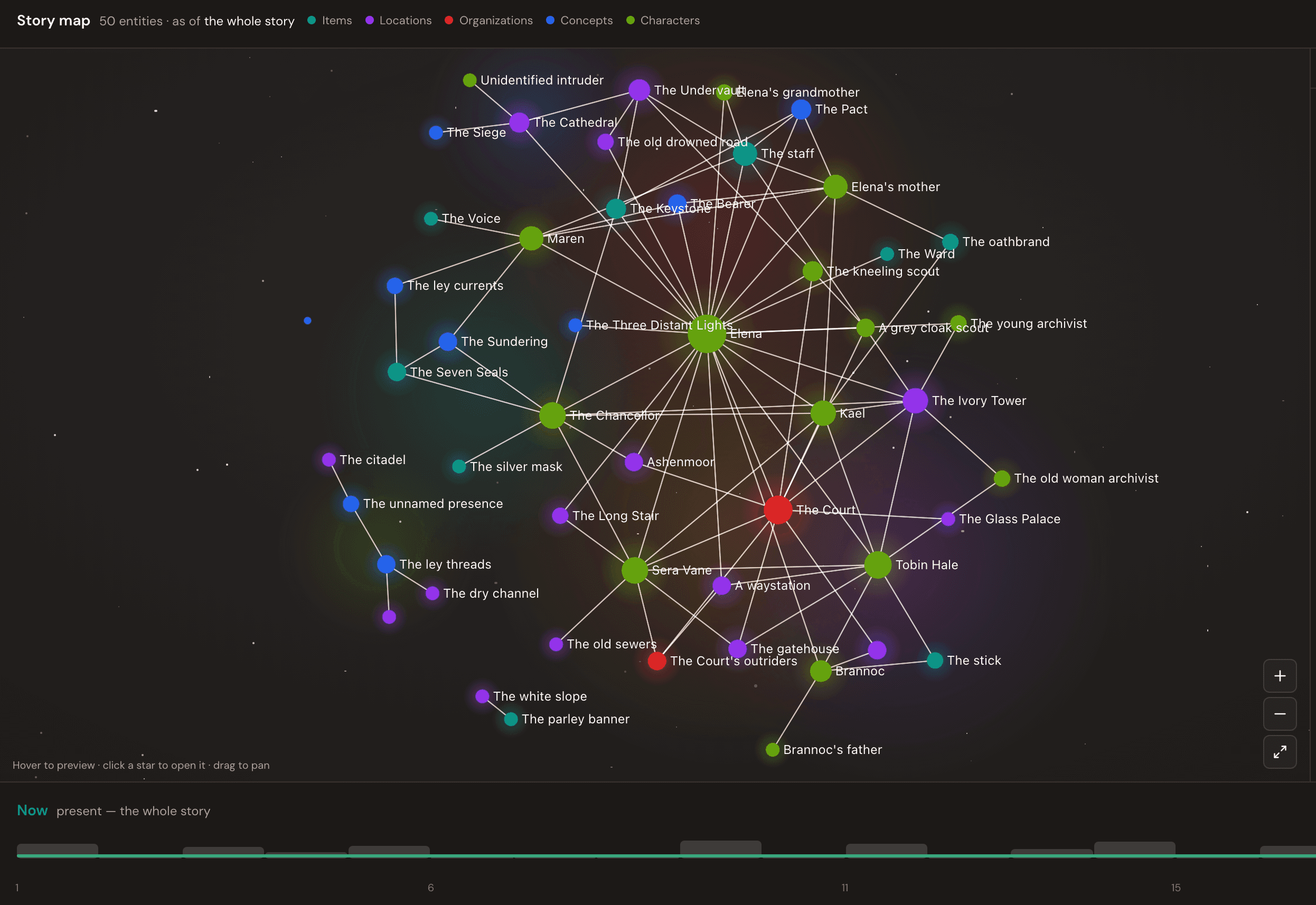
Drag the timeline back to chapter one.
The Atlas knows when every star first appeared and every thread was tied. Scrub backward and the map becomes what your reader knew at that chapter. That is exactly the question that matters when you’re writing chapter forty-one and can’t recall what chapter twelve’s reader hasn’t learned yet.
A map you can walk into
Every star opens to its receipts.
Hover a star to preview it. Click, and you’re in its story bible entry: the traits, the relationships, the exact lines of your manuscript that put it on the map. Every star opens, and every fact shows its line.
Your whole world, one map. And you never maintained a single node.
Questions writers ask
Do I have to build the map myself?
No. The Atlas is drawn from the story bible Pantser builds while you write in the workspace. Every character, place, item, and connection comes from your own chapters. You write, and the map draws itself.
What do the connections mean?
They’re your story’s actual relationships: who serves whom, who hates whom, what belongs to whom, who was there when it happened. Hover any star to preview it; click through to the full story bible entry and the quotes behind it.
Can I see the story as it stood in chapter one?
Yes. That’s the time scrubber. Drag the timeline back and watch the world contract to what your reader knew at that point: fewer names, fewer threads, the shape of your opening. It’s the fastest way to remember what chapter twelve’s reader hasn’t learned yet.
Is this useful before chapter fifty?
It’s useful the day the cast stops fitting in your head. For some stories that’s chapter eight. And it compounds: every chapter you write adds stars and threads, so the map is always exactly as big as your story.
See the story you’ve been carrying in your head.
Import your manuscript and the Atlas draws itself from your own chapters. The first 30,000 words are free.
Try it on your book, freeMore of the workspace
The writing workspace
A serious longform editor that reads along while you write.
The automatic story bible
Every character, place, and grudge, recorded without a form.
Continuity checking
Every new chapter checked against everything you’ve written.
Coming from another tool? See how Pantser compares.