The automatic story bible
Your story bible builds itself while you write.
Write your chapters in the Pantser workspace and the bible keeps itself: every character, place, and grudge recorded from your own prose, each entry quoting the line it came from. No sheets, no forms, no wiki to feed on your writing nights.
Try it on your book, free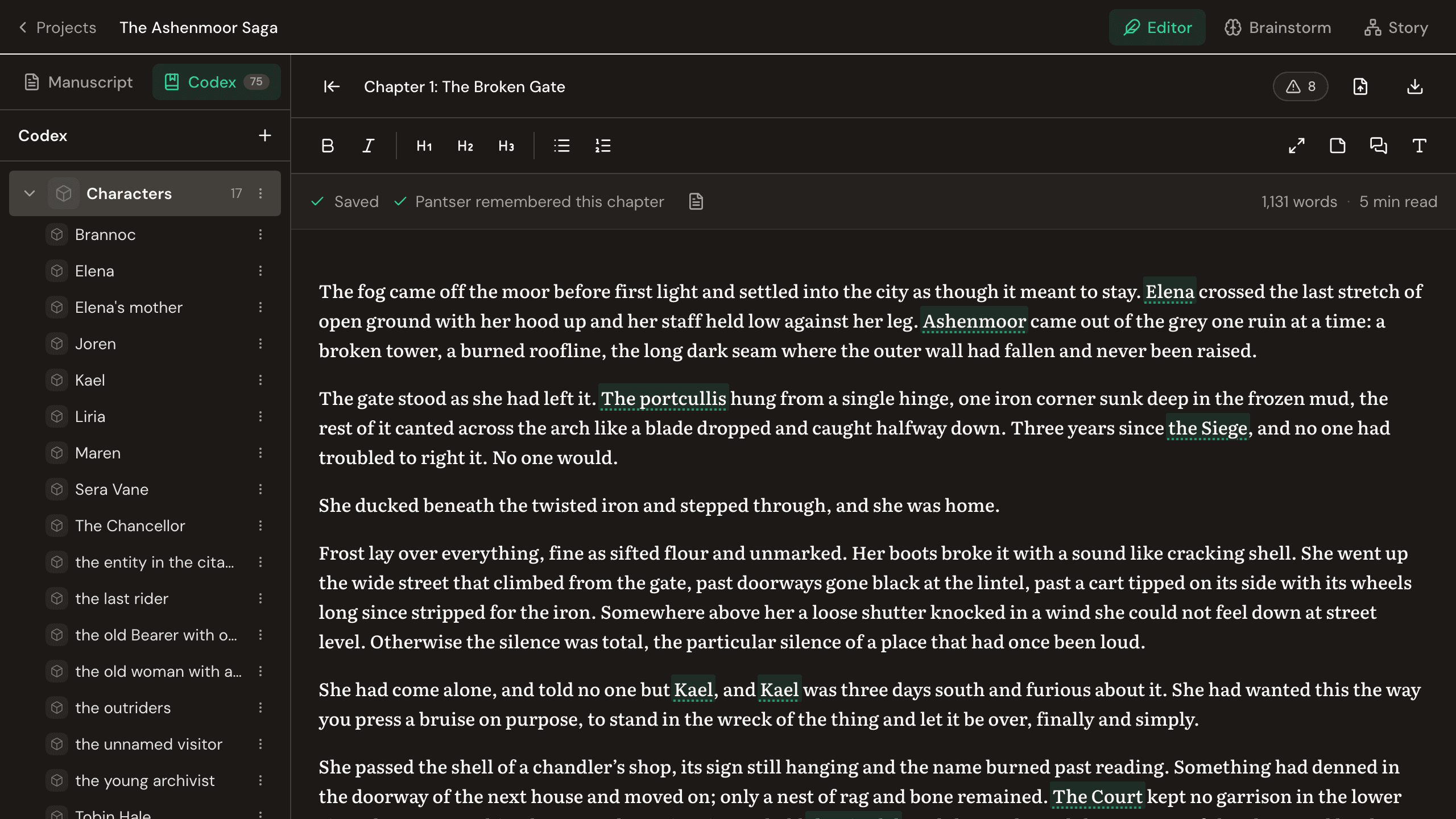
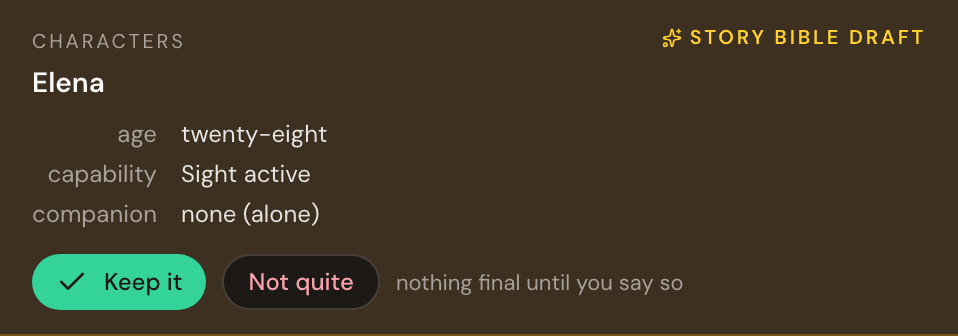
Nothing final until you say so
It suggests. You decide.
When Elena’s age, her Sight, or the fact that she came to Ashenmoor alone shows up in your prose, Pantser drafts the entry and waits. Keep it and it joins the bible. Not quite, and it’s gone for good. Suggestions never leak into anything until you’ve approved them.
What you’ve confirmed yourself is protected: a new chapter can’t quietly overwrite a fact you signed off on.
Receipts included
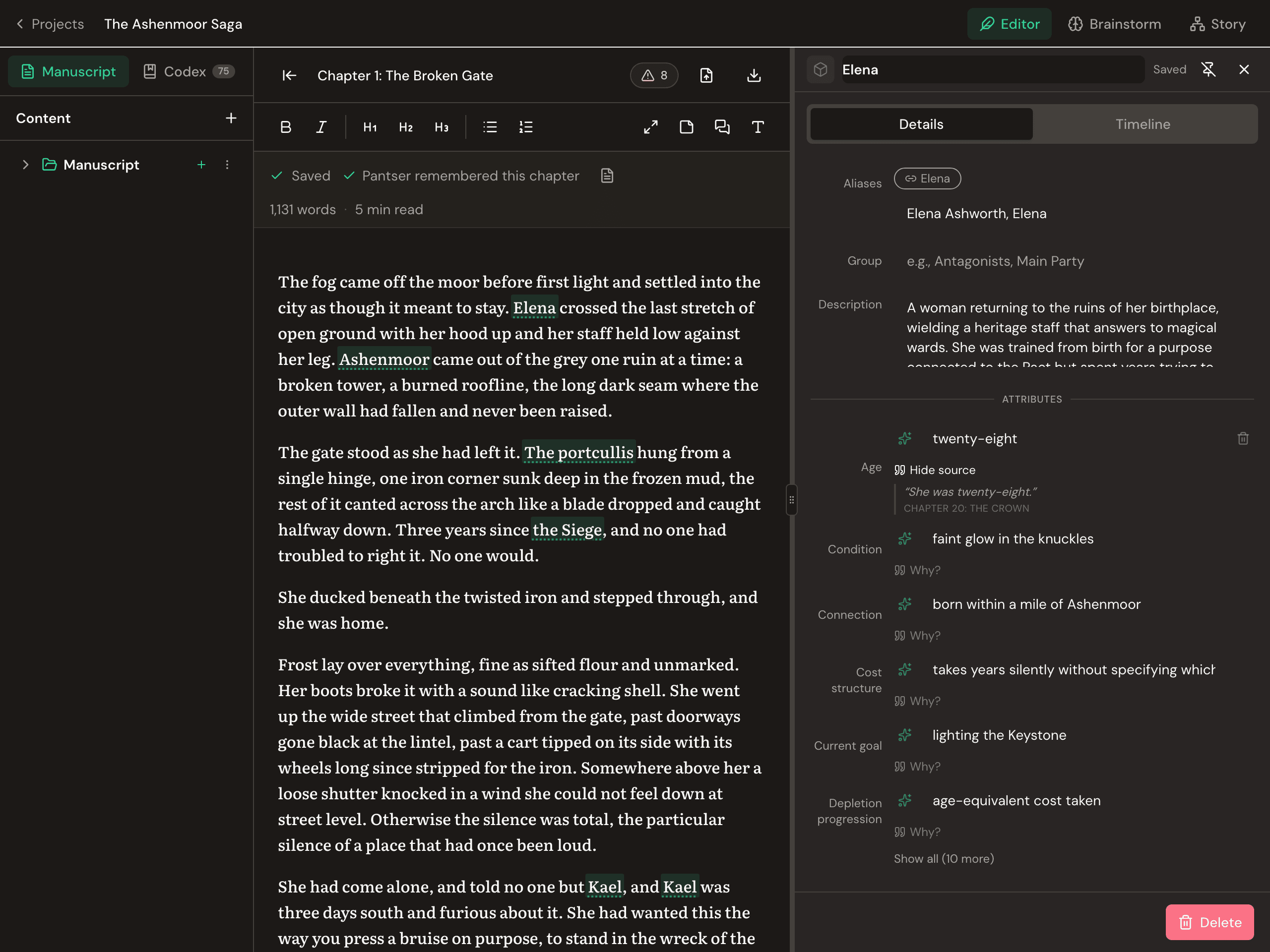
Every fact quotes the line it came from.
A story bible you didn’t write yourself is only useful if you can trust it. Open any entry and every detail points at the exact sentence in the exact chapter that put it there. One tap and you’re looking at your own words.
Twenty chapters. Seventy-five entries. You never maintained a single one.
Why it matters at chapter two hundred
The bible is how everything else knows your story.
The same entries power the continuity checks, draw the Story Atlas, and answer when you ask what a character knew in chapter twelve. The longer the story runs, the more the bible carries, and you still never filled out a form.
Questions writers ask
Do I have to fill out character sheets?
No, and you never will. Write your chapters inside the Pantser workspace and every character, place, heirloom, and grudge gets its own entry the moment it hits the page. The bible is a byproduct of writing, never homework before it.
What does the story bible track?
Characters, places, items, organizations, and concepts, plus their traits, their aliases, who hates whom, and what happened when. Each detail quotes the exact line of your manuscript it came from.
What if it gets something wrong?
Nothing goes in your story bible without your say-so. New entries arrive as suggestions with a Keep it and a Not quite button; the ones you toss stay tossed, and anything you’ve confirmed yourself always wins over a new guess.
Can I still write entries by hand?
Of course. It’s your bible. Add entries, edit anything, organize categories your way. Pantser keeps up. It just refuses to make you do the filing.
Does this work if I already have 100 chapters?
Yes, and that’s the best part. Import the manuscript and Pantser reads it in order, first page to last, building the whole bible from what’s already on the page. Twenty chapters or two hundred, you never fill out a form.
Your bible is already in your book.
Import your manuscript and watch the story bible assemble itself from your own chapters. The first 30,000 words are free.
Try it on your book, freeMore of the workspace
The writing workspace
A serious longform editor that reads along while you write.
Continuity checking
Every new chapter checked against everything you’ve written.
The Story Atlas
Your whole world drawn as one map, chapter by chapter.
Coming from another tool? See how Pantser compares.